Membrane Degassing
Water used in industrial processes must meet a wide variety of requirements. The concentrations of gases dissolved in the water after treatment play an important role in determining its quality. Gases that cause problems include oxygen, carbon dioxide, and, in rural areas, ammonia as well. Oxygen has an oxidative effect and accelerates bacterial growth. Carbon dioxide contaminates ion-exchange systems (dissociation into the various components of carbonic acid) and causes water quality limits to be exceeded.
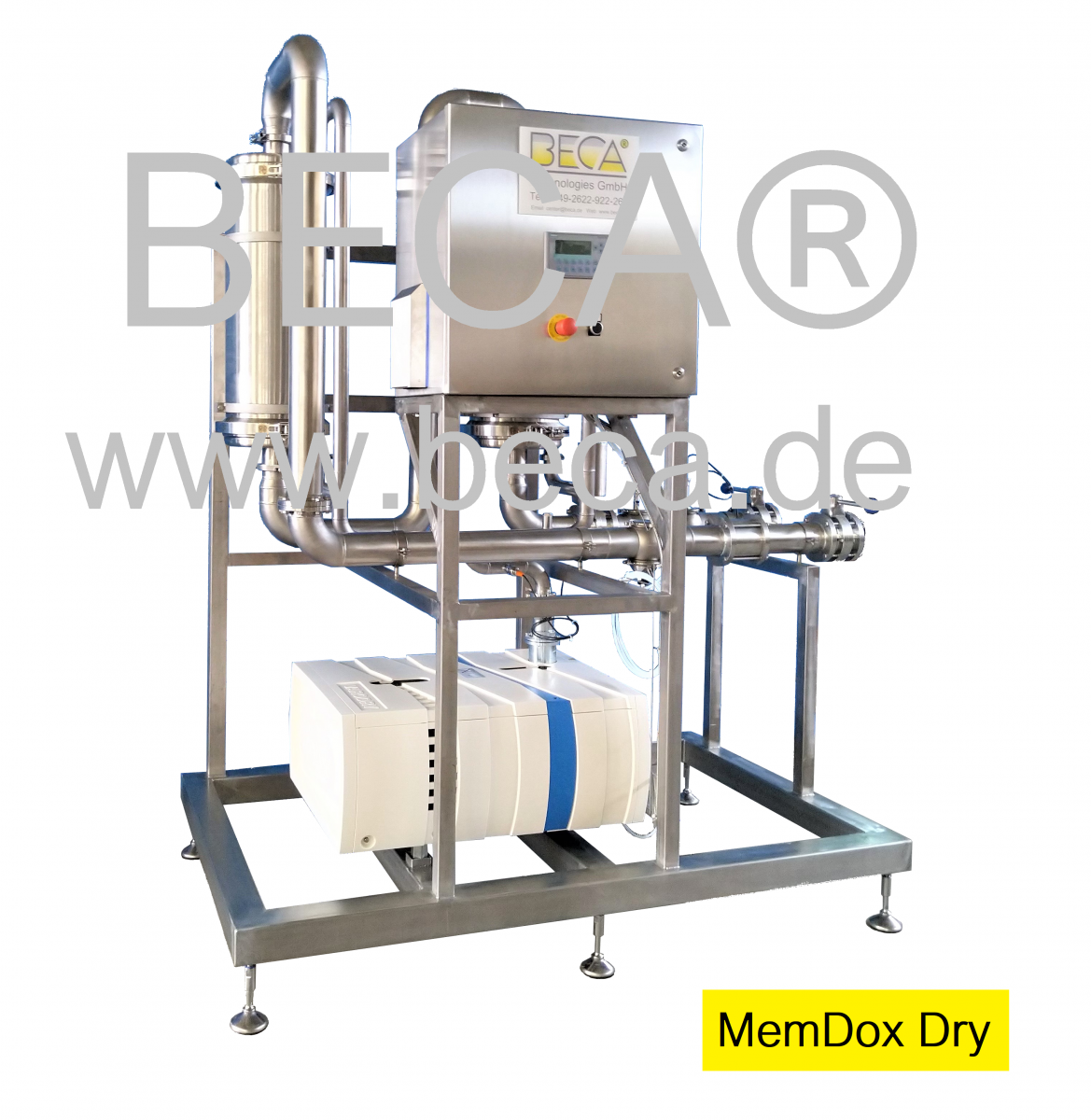
Membrane degassing is a membrane diffusion process in which a partial pressure gradient is applied to cause gases to diffuse through a membrane. The membrane is installed in a compact module. The compact module essentially consists of a housing, the membrane hollow-fiber bundle (hollow fibers and capillaries), the water distributor, and the gas connection. The water to be degassed flows radially outward from the centrally located distributor around the hollow-fiber bundle. The strip gas flows through the membrane on the lumen side (inside). Due to the membrane's hydrophobic properties, no water penetrates through the membrane into the gas phase.
Freshwater consumption and wastewater discharge not only harm the environment but also have a significant impact on your operating results.
Likewise, your customers demand the highest product quality, achieved through the lowest residual oxygen content and absolute purity.
We made their objective our mission and, in close collaboration with customers in the beverage industry, developed the cost-effective BECA® membrane cold degassing system.
The BECA® Barrier Water Circuit System, invented by BECA® in 1994, guarantees enormous savings in process water by utilizing the temperature difference between the barrier water and the degassing water.
The benefits of the BECA® membrane degassing system at a glance:
- Patented closed-loop water system that reduces fresh water and wastewater costs by more than 90%
- Residual oxygen levels after degassing: depending on the model, down to less than 0.01 mg/l
- Dead-Space-Free Diaphragm Modules
- Compact modular design – low investment costs
- Dead-space-free and loss-free inline CIP cleaning and sterilization
- Customization of the system design to meet customer needs
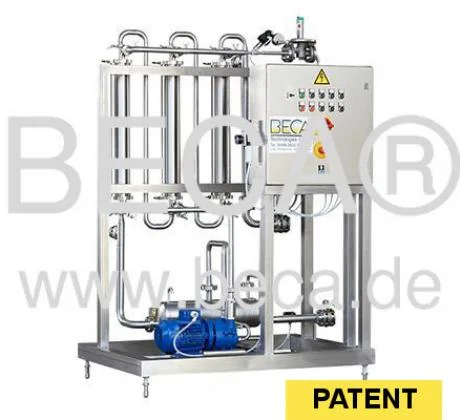
Version with a dry-running vacuum pump: