
Cross-Flow Filtration: Efficient Filtration for Demanding Process Media
Cross-flow filtration is a versatile method for separating solids and liquids in industrial processes. Unlike conventional filtration principles, the medium is not directed exclusively head-on against the separation surface, but rather moves tangentially along it.
BECA® does not view crossflow as an isolated filter, but rather as part of a comprehensive process solution that includes process engineering, flow control, pump technology, measurement and control technology, cleaning, and automation.
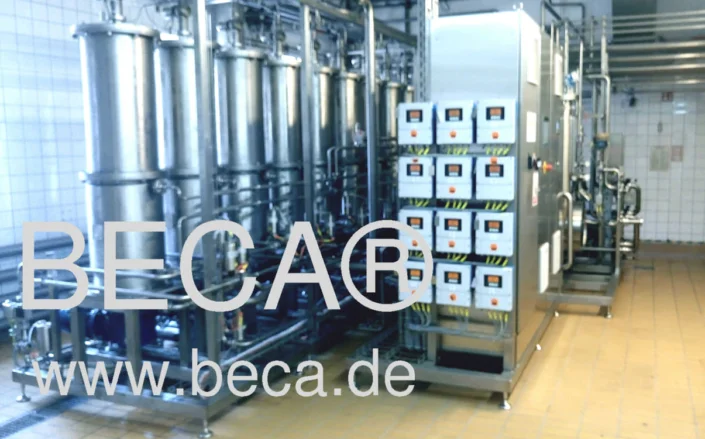
What is cross-flow filtration, and how does cross-flow work?
In tangential flow filtration, the fluid to be treated is directed parallel to the active separation surface. The flow pattern creates a continuous flow over the membrane surface. A portion of the liquid passes through the separation layer as filtrate or permeate, while larger particles or other retained components remain in the retentate.
The process is therefore also referred to as cross-flow filtration. In contrast to a separation stage with purely frontal flow, the suspension moves along the surface. The resulting shear forces can prevent solids from depositing unimpeded on the filter surface and quickly clogging it.
Among its distinctive features is the combination of separation and continuous movement of the material stream along the separation zone. BECA® considers not only the actual separation surface, but the entire process.
Cross-flow or dead-end filtration: What's the difference?
Both filtration processes are designed to separate substances, but differ significantly in terms of flow patterns and behavior at the filter surface.
Cross-Flow
In the cross-flow principle, the medium flows tangentially to the separation surface. Particles are therefore not pressed exclusively against the membrane, but are partially carried along with the stream of material .
- Tangential flow along the membrane surface
- It is possible to reduce the thickness of the top layer
- Suitable for continuous process control
- Retentate and permeate are routed separately
Dead-End Filtration
In dead-end filtration, the medium essentially strikes the separation surface head-on . Liquid passes through the pores, while solids are retained.
- Frontal flow across the separation surface
- Filter cake can build up during operation
- Flow resistance may increase as the layer thickens
- Suitable for other specific cutting tasks
Which filtration process is the better solution depends on the specific product . Solids content, viscosity, temperature, desired separation efficiency, transmembrane pressure, and cleaning strategy must all be considered together.
At BECA®, therefore, we do not simply select a standard component . Each system is designed based on the specific requirements of the process.
Why does tangential flow filtration reduce the surface layer and clogging?
Flow across the separation surface is one of the key differences compared to conventional filtration. In practice, this results in several process-related advantages.
Less Blockage
The tangential flow can reduce deposits on the surface and thus help prevent rapid clogging.
Continuous process
Permeate and retentate can be continuously separated and routed apart from each other during the ongoing process .
Gentle processing of the product
Speed, pressure, temperature, and flow pattern can be adjusted to suit the properties of the respective medium.
Integrated Process Engineering
Pumps, piping, automation, and cleaning can be designed together as a complete process system— .
In many separation processes, particles deposit on the active surface. The thicker this layer becomes, the greater the hydraulic resistance can become . Tangential flow , on the other hand, ensures that the medium moves along the membrane and that particles can be continuously carried away from the surface.
The shear forces involved must be appropriate for the specific application . The highest possible speed is not automatically the best solution. Delicate products should be handled as gently as possible , while other materials can tolerate or even require more intense handling.
High-quality processing therefore results from the interplay of speed, pressure, temperature, geometry, and medium. The cleaning strategy also plays an important role. A system that is properly sized from a technical standpoint can reduce fouling and blockages, thereby helping to ensure a long service life for the relevant components.
How do the membrane, retentate, and permeate function in cross-flow filtration?
The membrane—or the separation medium used— plays a key role in determining which components pass through and which are retained . The feed stream is directed along the separation surface . One stream of material passes through the separation zone, while a second stream contains the retained components.
Depending on the process, either the filtrate or permeate or the retentate may be the desired product. In a concentration process , for example, the retained phase can be concentrated in stages. In a clarification process , on the other hand, the focus is often on the permeate.
Unwanted components can then be further treated separately or discharged. That is why effective system design does not begin with the question of a specific membrane type, but rather with the desired process outcome.
BECA® Filtration Solutions →Microfiltration and Ultrafiltration
Depending on the separation task, the applications range from microfiltration to ultrafiltration. Separation ranges are described, for example, at in micrometers (µm) or, for very fine applications, in nanometers (nm) . In addition to traditional designs, hollow-fiber modules, hollow fibers, or capillary membranes can also be used.
For which suspensions and liquids is cross-flow filtration suitable?
Crossflow may be of interest for a wide range of suspensions and industrial process media. In general, this process is suitable for applications where components need to be separated from a liquid phase, concentrated, or recovered.
Brewing and Beverage Industry
Clarification, recovery, and product-specific separation tasks in liquid process media.
Food Industry
Treatment and separation of suspensions and liquid product streams.
Wine and Fruit Juices
Processing that preserves quality, as well as clarification and concentration processes.
Pharmaceutical Industry
Defined separation and concentration processes with controlled process control.
The medium is typically pumped through the system and directed in such a way that it continuously flows over the filtering surface. How well a particular suspension can be processed depends, among other things, on particle size, solids concentration, viscosity, temperature, and chemical properties.
Pre-treatment and storage of the product can also influence its subsequent separation behavior. Therefore, a specific application should not be evaluated solely on the basis of theoretical parameters . Depending on the medium, process data, laboratory results, or tests can provide an important basis for the design.
For food, wine, or fruit juices, a crossflow system can be used when particles need to be separated, product streams need to be clarified , or certain components need to be further concentrated. A potential process engineering advantage may also lie in the elimination of filter aids, provided that the crossflow process can replace a corresponding conventional process step.
This can result in advantages in terms of handling and disposal . Whether this is feasible in a specific production process and economically viable must be assessed on a case-by-case basis.
Two cross-flow principles. One solution tailored to your process.
The appropriate crossflow variant depends on the medium, solids content, desired throughput, process control, and separation task. BECA® offers a variety of technical concepts, so that a single system design does not have to be applied to every application.
Dynamic Crossflow
In dynamic crossflow, the hydrodynamic effect at the separation surface is additionally influenced by moving system components. This allows the relative motion between the separation surface and the product to be generated differently than in a system driven exclusively by flow .
High solids content, product properties, desired throughput , or the sensitivity of the medium can influence the selection of this technology.
Discover Dynamic Crossflow →Static Inline Crossflow
In the static principle, the necessary relative motion at the interface is primarily caused by the flow of the medium. Flow rate, duct geometry, and velocity significantly determine the conditions at the surface.
Such concepts may be particularly well-suited for compact and continuously configured process lines.
Discover Static Inline Crossflow →What are the advantages of tangential flow filtration in the pharmaceutical industry and process engineering?
Tangential-flow filtration is also used in the pharmaceutical industry and in other areas of general process engineering for specific separation and concentration tasks. Depending on the process, for example, particles, cellular components, or other constituents can be separated from one another based on their size and retention behavior.
In addition to the actual separation performance, materials, hygienic design, cleanability, reproducible process conditions, and reliable automation play an important role. Depending on the medium, operation at low pressure or a flow pattern that is particularly gentle on the product may also be required.
The plant must therefore be considered a process system. BECA® combines process engineering design—upon request—with planning, engineering, automation, installation, and commissioning.
Crossflow is more than just a membrane.
BECA® designs the separation stage as part of a complete process plant. Pumps, tanks, piping, valves, measurement and control systems, cleaning, and automation can all be designed together .
As a result, this concept is particularly well-suited for projects in which crossflow should not be planned in isolation from the rest of the production line.
Process Analysis
The medium, throughput, solids content, and desired separation result form the basis for the design.
Process Engineering
Pump design, flow path, diaphragm design, process parameters, and cleaning are all considered together.
Automation
Pressures, flow rates, temperatures, and process conditions can be monitored and controlled .
Manufacturing & Integration
The cross-flow stage can be integrated into new systems or existing production environments.
Commissioning & Service
BECA® supports projects through to commissioning and can also handle service and lifecycle tasks .
What Factors Affect the Cost-Effectiveness of Cross-Flow Filtration?
The cost-effectiveness of an industrial plant does not depend solely on the purchase price. Equally important are product losses, throughput, energy consumption, cleaning costs, plant availability, wear parts, and potential downtime.
A technically suitable system can be more cost-effective over its entire service life than a system that is initially less expensive but is not optimally suited to the product. Especially when dealing with demanding media, the pump design, flow velocity, available separation surface, and cleaning procedures must be coordinated.
Automation also plays an important role. Depending on the system design, production, rinsing, or cleaning sequences can be performed automatically . This helps ensure consistent operation.
When is a BECA® cross-flow solution the right choice?
A cross-flow solution is particularly useful when complex separation of solids from a liquid, recovery, or concentration is required, and conventional systems reach their technical or economic limits .
What matters here is not the buzzword “cross-flow,” but rather the results achieved in the actual process. The system must enable the desired mass transfer, be compatible with the medium, and be capable of stable, long-term operation.
A BECA® solution can range from the actual separation stage, through pumps and piping, to measurement and control technology, software, cleaning, and commissioning. This makes the concept particularly well-suited for companies that are not looking for a standalone filter machine, but rather a integrated process engineering solution.
The Most Important Facts About Cross-Flow Filtration at a Glance
Crossflow combines a specific separation task with flow control along the membrane surface, as described at . The appropriate technical solution always depends on the actual process.
- The medium flows tangentially to the interface and not exclusively head-on toward it.
- Cross-flow can limit the formation of a thick surface layer .
- Retentate and permeate enable clarification, concentration, and recovery processes.
- The membrane, pressure, velocity, temperature, and product properties must be considered together.
- Crossflow is suitable for numerous applications in the beverage, food, pharmaceutical, and general process engineering industries.
- BECA® offers both dynamic and static inline cross-flow solutions.
- Cleaning, automation, energy consumption, product losses, and system availability all affect cost-effectiveness.
- BECA® can integrate cross-flow technology—from engineering to turnkey process solutions— .
Which cross-flow solution is right for your process?
The medium, throughput, solids content, temperature, and desired separation result form the basis for the design. Discuss your application directly with BECA® at .